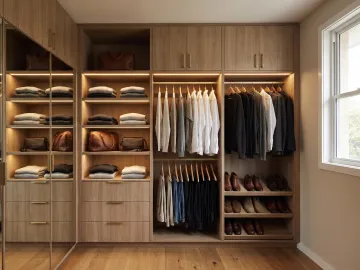
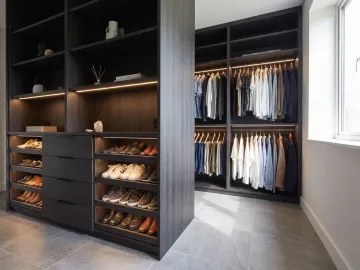
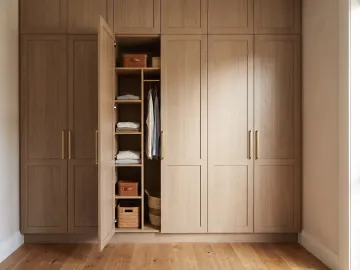

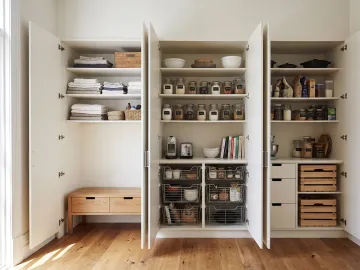
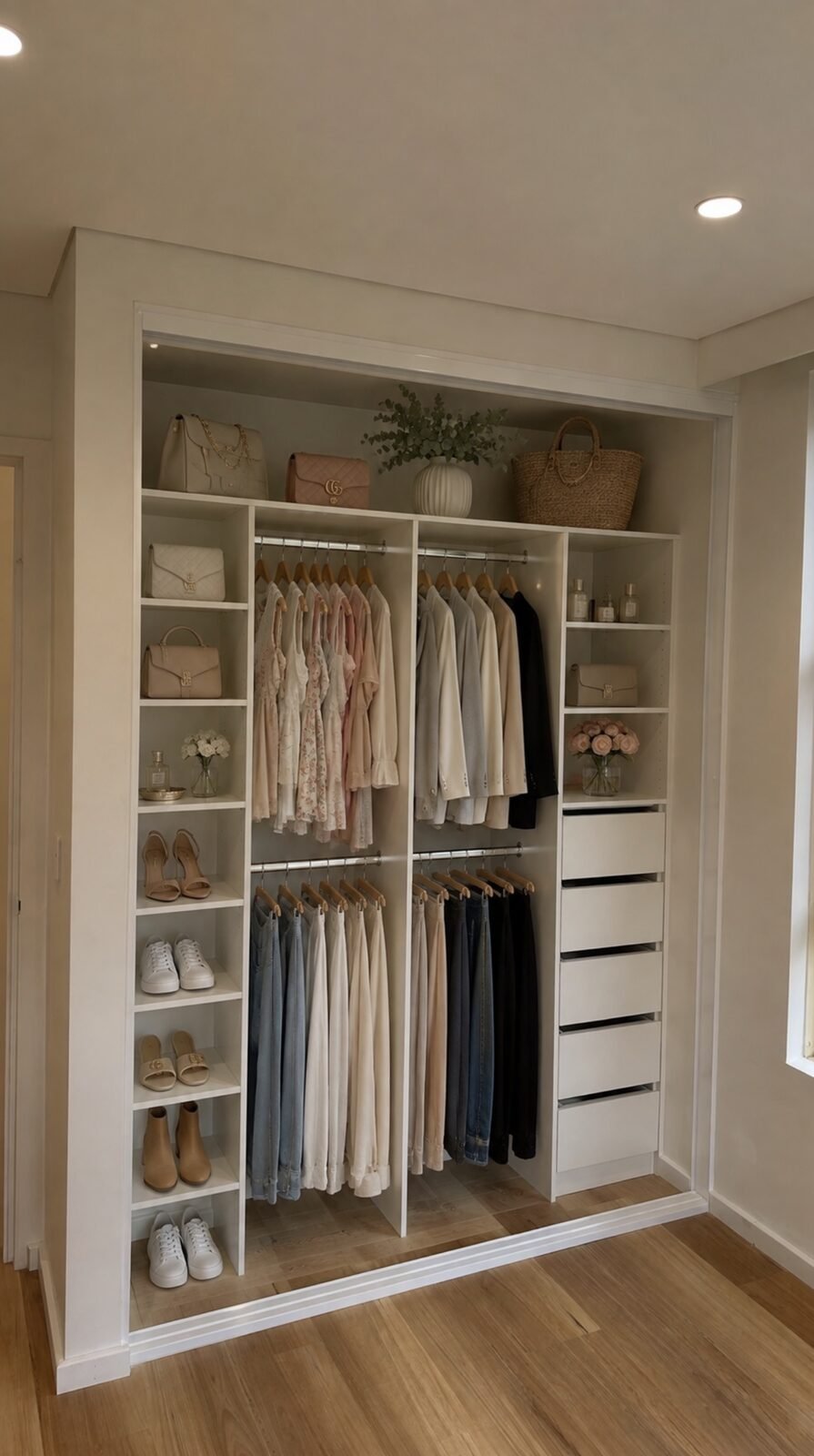
Short answer: a standard hanging rail needs about 550mm of internal depth. A recess shallower than that gets end-on rails (front to back, hangers facing you), pull-out rails, or a layout built around shelving and drawers instead of hanging. Where the room allows, the wardrobe can be built forward of the recess to reach full depth. Shallow is a design constraint, not a dead end.
Why 550mm matters
A coat hanger is about 450mm across. On a side-to-side rail the hanger sits across the depth of the wardrobe, so with the rail centred and the clothes on it, about 550mm is needed before the doors close without pressing on the shoulders. A 450mm recess, which is common in older homes and in apartments, cannot take a standard rail.
Option 1: end-on rails
Rails that run front to back, so the hangers face the doors and the clothes are seen edge-on. Each rail is about 300 to 400mm long and holds 10 to 15 hangers. Several side by side across the wardrobe replace one long rail.
- Depth needed: about 350mm.
- Holds: less per metre than a standard rail, but far more than a shallow wardrobe with no rail.
- Suits: shirts, jackets, trousers on hangers. Awkward for very wide coats.
Option 2: pull-out rails
A rail on a telescopic arm that pulls out towards you, with the hangers facing the room when extended and the clothes sitting front to back when retracted.
- Depth needed: about 350 to 400mm.
- Holds: 10 to 15 hangers per rail.
- Suits: a shallow bay where you want to see the clothes face-on. Runs on ball-bearing slides.
Option 3: shelves and drawers instead of hanging
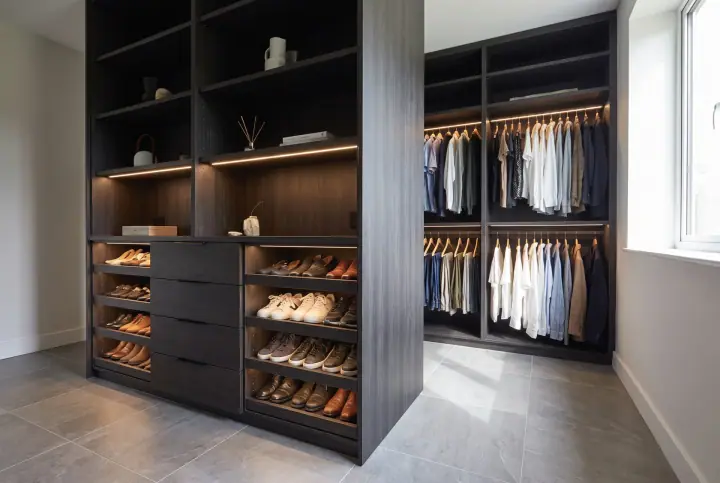
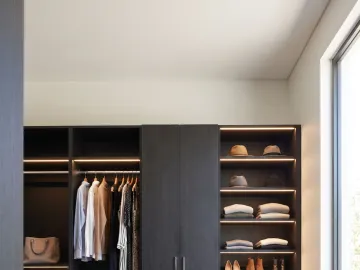
If the shallow recess is one of several wardrobes, give it the folded clothes and let a deeper wardrobe elsewhere take the hanging.
- Shelves at 300 to 350mm deep, close-spaced, for folded clothes, shoes and bags.
- Drawers at 350 to 400mm deep, full-extension.
- Depth needed: 350mm.
- Holds: a great deal of folded storage. A 450mm-deep wardrobe of shelves and drawers is a very good dresser.
Option 4: build forward
Where the bed and the door allow, the cabinetry comes forward of the recess by 100 to 200mm, so the internal depth reaches 550 to 600mm and a standard rail fits. The doors sit flush with the new face, and the recess walls become the sides of the wardrobe.
- Depth gained: whatever the room can spare.
- Suits: a recess of 400 to 500mm in a room with space in front.
- Watch for: the door swing and the bed. Sliding doors on the new face need no clearance.
Option 5: a mix
The usual answer. One bay built forward with a standard rail, the rest shallow with end-on rails, shelves and drawers.
Depths at a glance
| Internal depth | What fits |
|---|---|
| 300 to 350mm | Shelves, end-on rails, slim drawers |
| 350 to 450mm | End-on and pull-out rails, drawers, shoe shelves |
| 450 to 550mm | As above, plus a standard rail only with slim hangers and tight doors (not recommended) |
| 550 to 600mm | Standard rail, full internals |
Doors on a shallow wardrobe
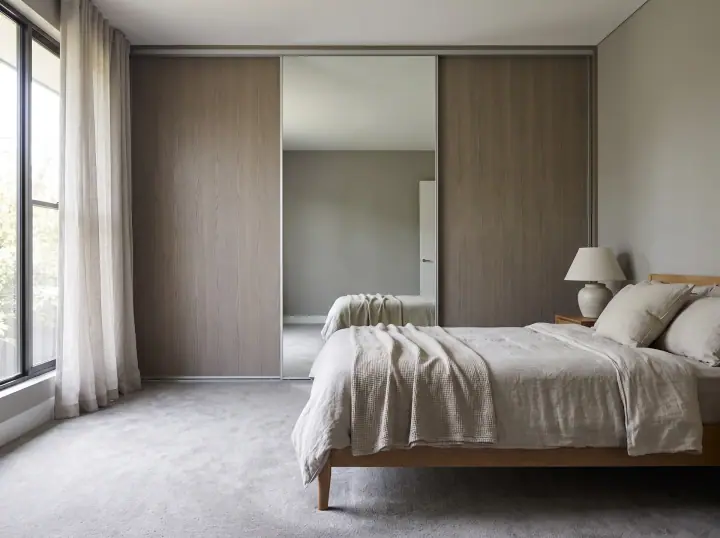
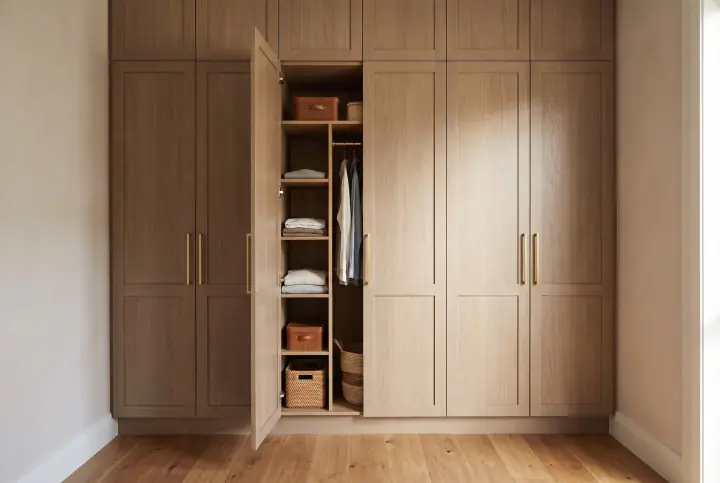
Sliding doors take a little depth for the track and overlap, so on a very shallow robe hinged doors leave more room inside. On a built-forward robe, sliding doors on the new face are the usual choice. Our sliding vs hinged guide covers it.
Apartments and older homes
Shallow recesses are common in apartments (the builder’s 500mm module) and in older houses where the recess was built for a freestanding wardrobe. Our apartment guide and older homes guide cover those rooms.
At the consult
The designer measures the depth at both sides (shallow recesses are often not the same depth across), looks at the room in front, and recommends one of the options or a mix. A shallow wardrobe designed properly is a good wardrobe; it is only a bad one when a standard rail is forced into it. The cabinetry is made to the recess in our Blacktown factory and fitted by the licensed installer who measured it.