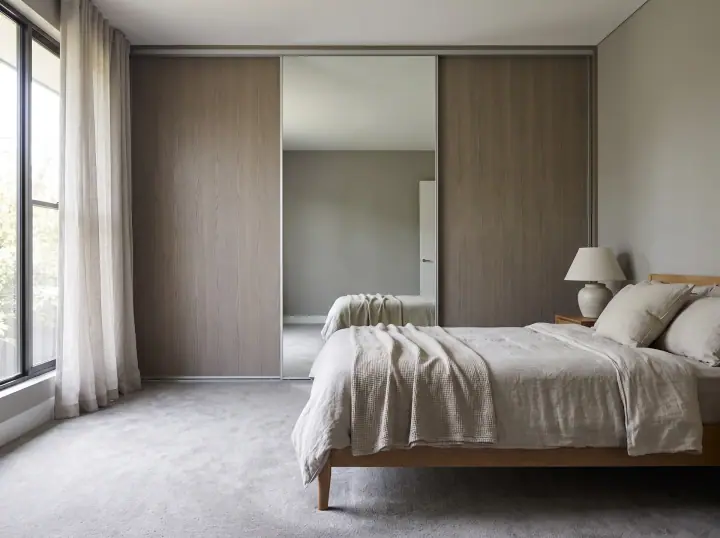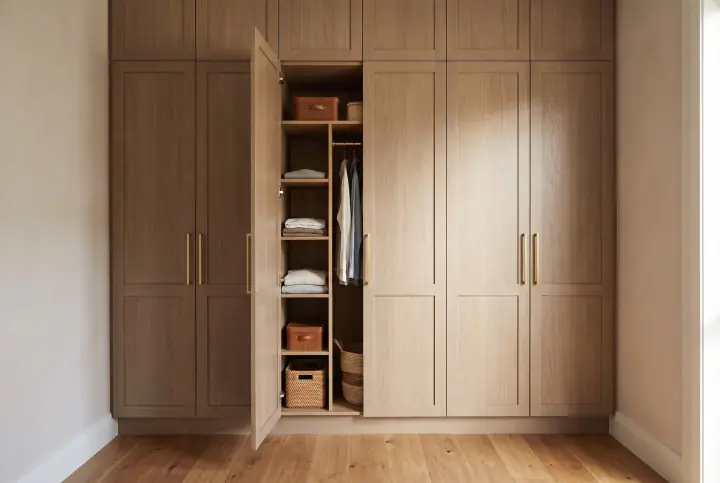
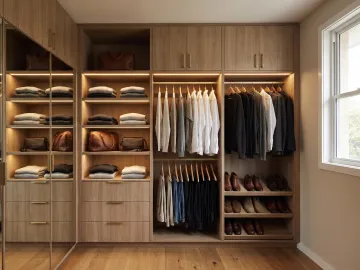
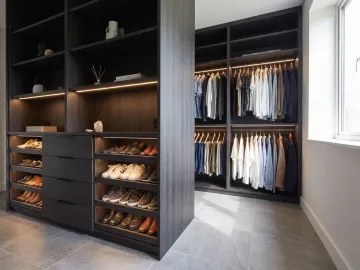
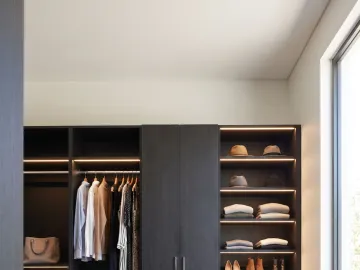
Short answer: sliding doors need no clearance in front of the wardrobe, so they suit compact bedrooms and rooms where the bed sits close to the robe. Hinged doors swing open and show the whole wardrobe at once, so they suit rooms with space in front and anyone who hates reaching around a fixed panel. Neither is better. One of them is right for your room.
Sliding doors
Sliding doors run on a track, overlapping each other as they glide sideways. With two doors, half the wardrobe is open at any time; with three doors on a wide opening, roughly a third.
Pros
- No clearance needed. The bed, a chest of drawers or a desk can sit right in front. In a small bedroom this is the whole argument.
- Big, uninterrupted panels. A floor-to-ceiling mirror door is a wall of mirror. A white-glass door is a wall of gloss. The room looks larger.
- Floor to ceiling, wall to wall. Custom sliders are made to the opening, so there is no filler panel above or beside them.
- Safer for kids. Nothing swings into the room.
Cons
- You see half at a time. You slide the door across to reach the other side.
- The track takes a little depth. A two-door sliding system needs a wardrobe a touch deeper than a hinged one, to allow for the overlapping doors.
- Heavy glass needs good hardware. Mirror and glass doors are heavy. The track and rollers have to be up to it, or the doors drag.
Hinged doors
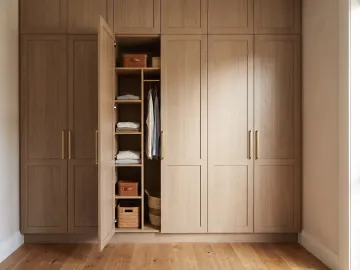
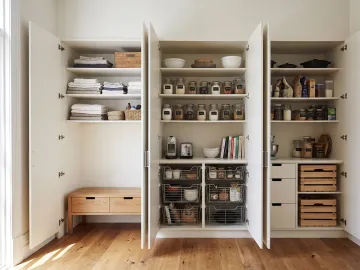
Hinged doors are the traditional swing door, fitted on concealed hinges to a frame. Open both and the entire opening is in front of you.
Pros
- Full access. Every shelf, rail and drawer in view at once. If you organise by outfit, this matters.
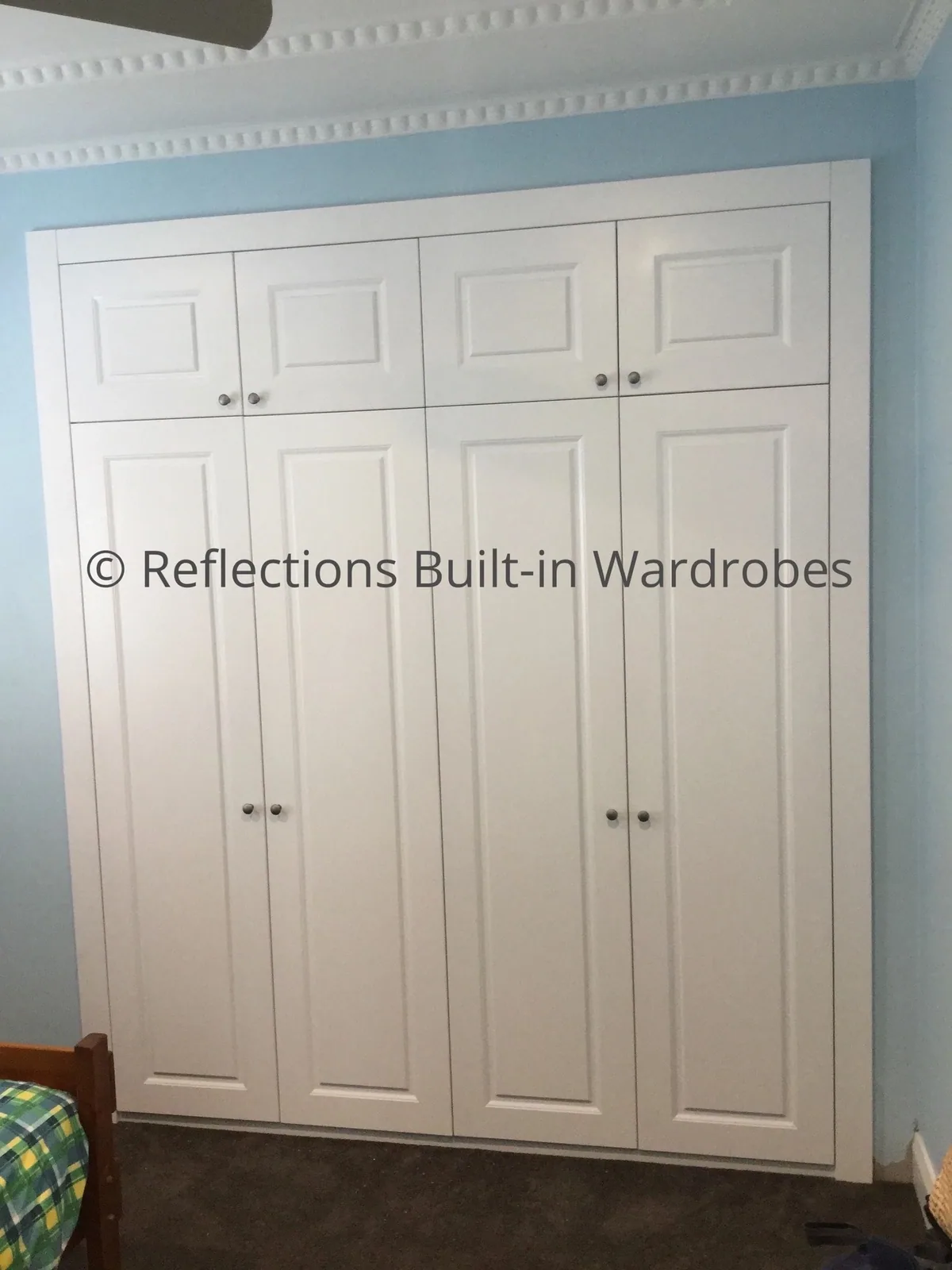
- Door styles. Flat panel, routed shaker or raised profile, colour-matched to the architraves and skirting. Hinged doors suit older homes and more traditional rooms.
- Overhead cupboards. A hinged door above a hinged door is the natural way to take a robe to the ceiling in a tall room.
- Inside the door is usable. A tie rack, a hook or a slim mirror on the back of a hinged door.
Cons
- They need swing room. Roughly the width of each door in front of the robe. If the bed sits within 600mm of the wardrobe, hinged doors will clash with it.
- More doors on a wide opening. A 3.6 metre opening is six hinged doors, which is a lot of handles. Sliding doors handle wide openings more gracefully.
Room by room
| Room | Usually choose | Because |
|---|---|---|
| Small bedroom, bed close to the robe | Sliding | No clearance needed |
| Main bedroom with space in front | Either | Decide on look and how you dress |
| Kids’ room | Sliding | Nothing swings; mirror doors make it feel bigger |
| Hallway or linen cupboard | Hinged | Narrow openings, full access to shelves |
| Wide opening (over 3m) | Sliding | Fewer, larger panels |
| Older home with timber trims | Hinged with a routed profile | Matches the house |
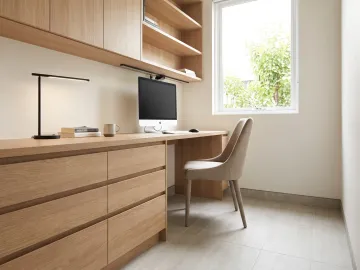
| Home office or study robe | Hinged | Shelves and files need the whole opening |
What the doors are made of
Both types are available in the full polytec wardrobe range: matt and woodmatt colours, textured finishes and routed shaker profiles. Sliding doors use polytec’s 9mm wardrobe door board, made for the job, and can also be mirror or white glass. Hinged doors are usually 16mm or 18mm board. Our colours and finishes page shows the range.
The hardware is the difference between good and bad
A sliding door that glides for ten years is riding on ball-bearing rollers in an aluminium track, hung from the top. A sliding door that jumps its track is on plastic wheels in a floor channel. A hinged door that closes softly and stays aligned is on quality concealed hinges. Ask any wardrobe company what hardware they fit, because the doors look the same on day one.
Our recommendation, honestly
At the onsite consult the designer looks at where the bed goes, how much room is in front of the wardrobe and how you use it, and recommends sliding or hinged on that basis. Both are made to the opening in our Blacktown factory and fitted by the licensed installer who measured them.