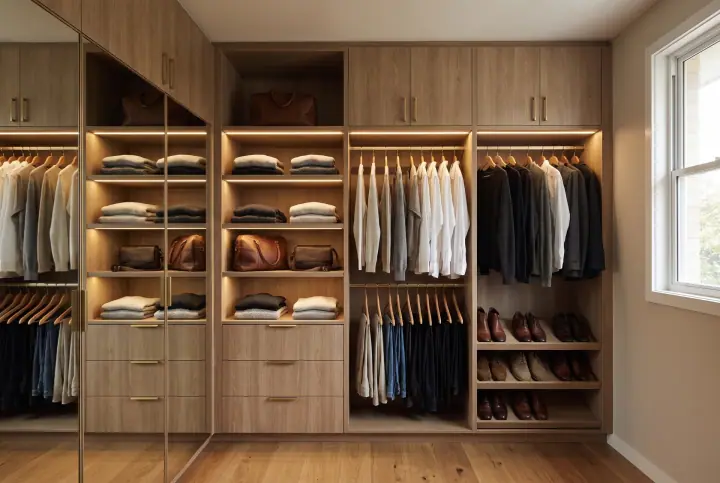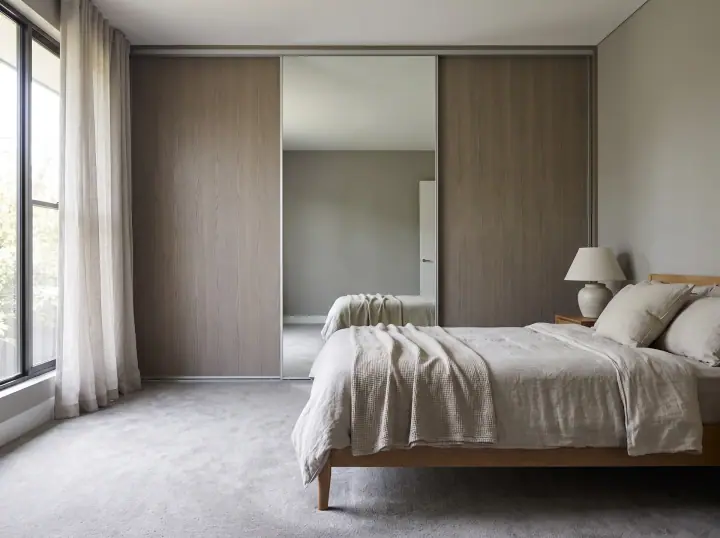
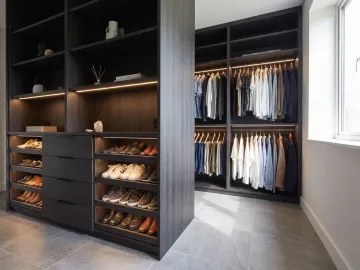
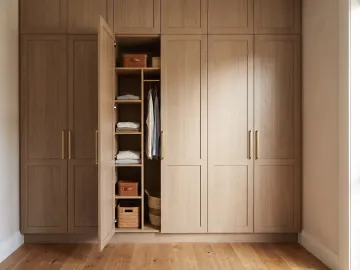
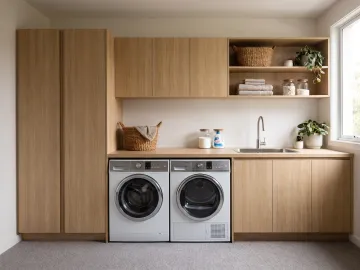
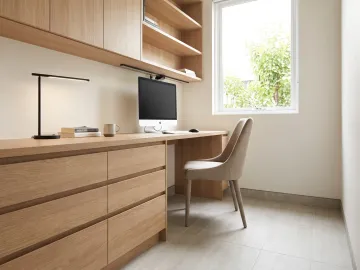
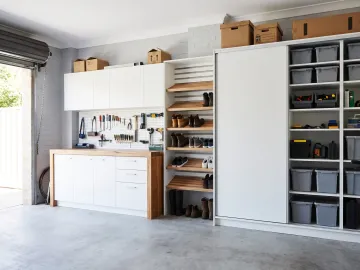
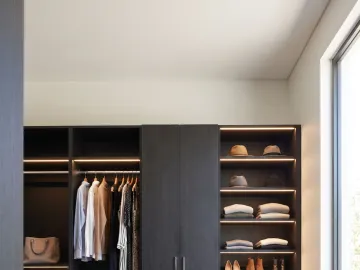
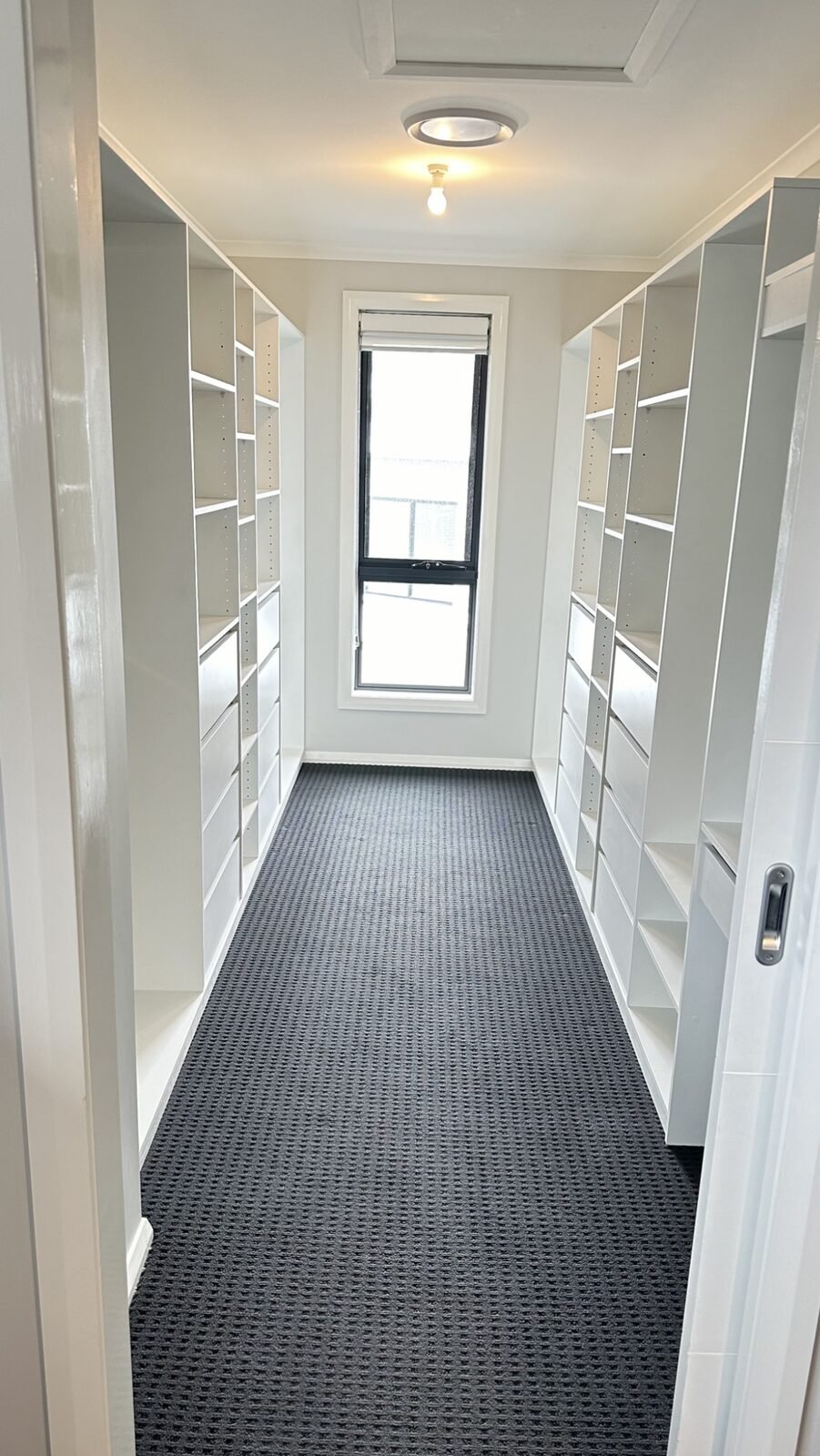
Short answer: timber-look wardrobes are polytec’s woodmatt (a timber print under a matt, lightly textured finish) and ravine (a deeper grain texture that follows the print). Light and natural oaks are the safe choice; smoked oaks and walnuts are features. Use timber-look on one plane (the doors, or the walk-in shelving) and white on the rest, so the result is warm rather than heavy.
Woodmatt and ravine
Woodmatt has a fine surface texture and a matt sheen, with the timber print showing through. It reads as timber at a glance, and up close it reads as a very good print. It is the finish used on most timber-look wardrobes and kitchens.
Ravine has a pronounced grain texture, embossed to follow the print, so it feels like sawn timber under the hand. It is the finish to use where the doors are a feature and will be touched.
Both are melamine board: no oil, no polish, wipe with a damp cloth. Both come in the same range of oaks, walnuts and a few darker timbers.
The timbers
| Look | Character | Use |
|---|---|---|
| Blonde or natural oak | Pale, warm, calm | Walk-ins, kids’ rooms, small rooms |
| Light grey oak | Cooler, modern | Rooms with grey floors or cool walls |
| Natural or bronzed oak | Mid-tone, warm | Feature doors in a main bedroom |
| Smoked oak | Dark, warm | Feature doors in a large room |
| Walnut | Dark, red-brown, formal | Traditional or formal rooms |
Match the undertone to the floor. A warm timber floor wants a warm oak; a grey-washed floor wants a grey oak. Our colours guide covers matching.
Where to use it
On the doors
Timber-look sliding or hinged doors on a white carcass. The wardrobe is a warm wall in the room; inside, it is bright white. The most common use.
In a walk-in
Timber-look shelving and drawer fronts with no doors, so the walk-in feels like furniture. Pair with white carcasses or go full timber-look in a large walk-in with good light.
As one panel
A single timber-look door among white ones, or a timber-look end panel on a white robe. A touch of warmth without committing a whole wall.
Not everywhere
A small, dim bedroom with timber-look doors, carcass and shelving is a cave. Keep timber-look to one plane and let white do the rest.
Combinations that work
- Blonde oak doors, white carcass, white internals. The standard.
- White sliding doors, blonde oak walk-in. The main suite with a walk-in off it.
- Smoked oak hinged doors, white trims. A feature wall in a large main bedroom.
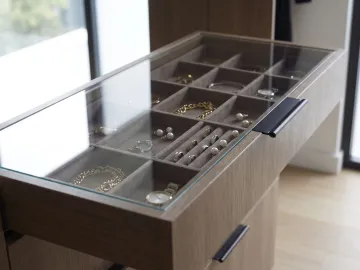
- Natural oak drawer fronts, white shelving in a walk-in. Warm where you touch it, bright where you look.
Combinations to avoid
- Timber-look doors fighting a timber floor of a different undertone.
- Timber-look everything in a small room.
- Two different timber looks in one wardrobe.
- A dark walnut in a south-facing bedroom.
Matching a kitchen
If the kitchen has a woodmatt oak, the designer can usually match it from the same range, so the house reads as one. Bring a kitchen door sample or a photo to the consult.
Care
Damp cloth, wipe along the grain, dry. No oil, no polish, nothing abrasive. Our care guide has the detail.
At the consult
The designer brings woodmatt and ravine samples in your shortlisted timbers and holds them against your floor and walls in your light. The right oak in a sample is obvious in a way a chart never is. Doors and shelving are cut and edged in our Blacktown factory and fitted by the licensed installer who designed them. See the colours and finishes page for the range.