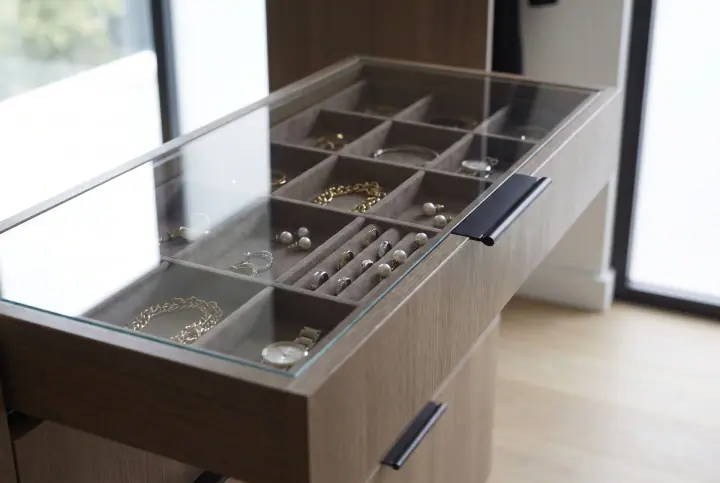










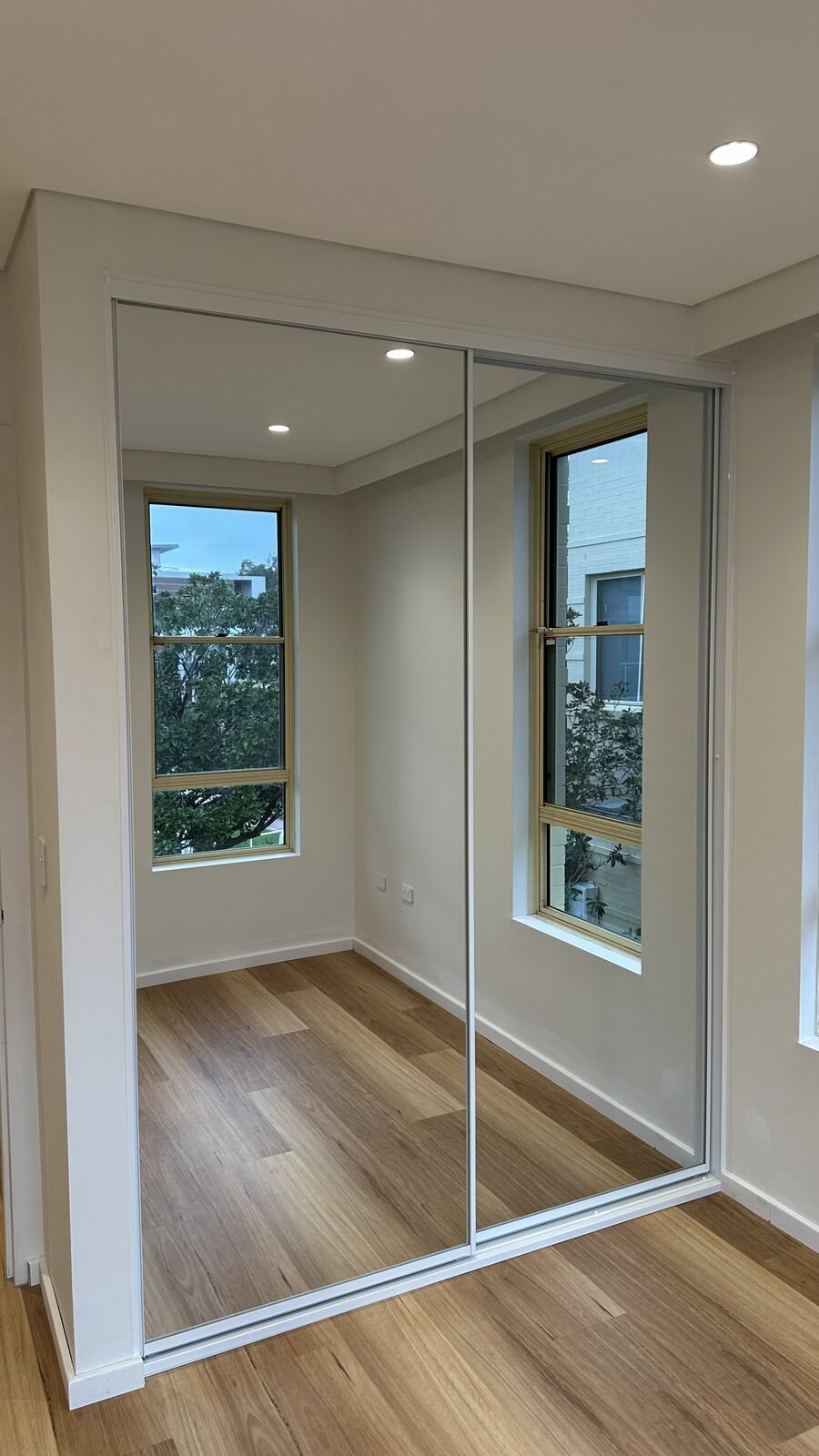
Short answer: wardrobe doors need very little care. Mirror and glass: glass cleaner on a cloth, not on the door. Matt, woodmatt and textured: warm water, a drop of dishwashing liquid, a soft cloth, wipe dry. Tracks: vacuum the floor guide now and then. Drawers and shelves: do not overload them. That is most of it; the rest is below.
Mirror doors
- Spray glass cleaner onto a microfibre cloth, not onto the mirror, so nothing runs behind the mirror edge or into the frame.
- Wipe in one direction, then buff with a dry cloth.
- Avoid abrasive cloths and ammonia-heavy cleaners, which can mark the silvering at the edges over time.
- Fingerprints around the handle come off with the same cloth.
White glass doors
The glass is painted on the back, so the face is plain glass:
- Glass cleaner on a cloth, as above.
- Nothing abrasive. The front is hard to mark, but a scourer will scratch it.
- Fingerprints show less than on mirror because there is no reflection.
Matt and textured polytec doors
- Warm water with a little dishwashing liquid on a soft cloth.
- Wipe, then dry with a clean cloth so there are no streaks.
- Avoid cream cleansers, scourers, bleach and solvents. They dull the matt surface.
- For a scuff, a melamine foam eraser used lightly. Test on a hidden spot first.
- Textured finishes hold dust in the grain; a soft brush or a dry microfibre cloth first, then the damp cloth.
Woodmatt and ravine doors
Same as matt. The timber look is a print under a matt finish, so it does not need oil or polish, and polish will leave a film. Wipe along the grain.
Sliding door tracks
- The bottom guide collects dust and the occasional sock. Vacuum it when you vacuum the room.
- The top track, where the rollers run, rarely needs anything. If the door starts to drag or sit unevenly, the rollers can be adjusted with a screwdriver through the access point in the frame, which the installer shows you on the day.
- Do not oil the track. Oil holds dust.
Hinged doors
- Concealed hinges are adjustable. If a door drops or the gap changes, a quarter turn of the adjustment screws fixes it. Ask the installer to show you which screw does what.
- Soft-close hinges need nothing.
Drawers
- Ball-bearing runners need no lubrication.
- Do not overload. A drawer full of jeans is fine; a drawer full of books is not what it is for.
- If a drawer front sits unevenly, it adjusts at the runner clips.
Shelves and rails
- Adjustable shelves can be moved any time on their pins.
- A rail over its design load will bow. Spread heavy coats across bays.
- Wipe shelves with a damp cloth. Shelf liners are optional; the melamine surface is easy to clean.
Inside the wardrobe
- Moths and silverfish: cedar blocks or lavender sachets in the drawers, and clean clothes before storing for the season.
- Damp: a wardrobe on an external wall in an older home can be cold. Leave a small gap behind the clothes, and if there is a musty smell, a moisture absorber on the top shelf.
- Dust: doors keep it out. A walk-in with open shelving wants a wipe of the shelf edges a few times a year.
When to call
A door that will not sit square after cleaning the track, a drawer that will not close, or anything that has moved: these are small adjustments and part of what the workmanship guarantee covers. Every Reflections wardrobe carries a 10-year workmanship guarantee, and the installer who fitted it is the person who comes back.