
Short answer: most sliding door problems come from bottom-rolling doors in a floor channel: dust and wear make them jump and drag, and they cannot be adjusted. Top-hung doors on an aluminium track do not jump; if one sits crooked, it is a roller adjustment. Clean the track and bottom guide first; if the doors are on a floor channel and more than a few years old, the fix is new doors on a proper track.
The two systems
Bottom-rolling (floor channel): the door’s weight sits on wheels that run in a channel on the floor. Standard on flat-pack and older wardrobes. The channel collects dust and grit, the wheels wear flat, and the door jumps out when it hits a bump.
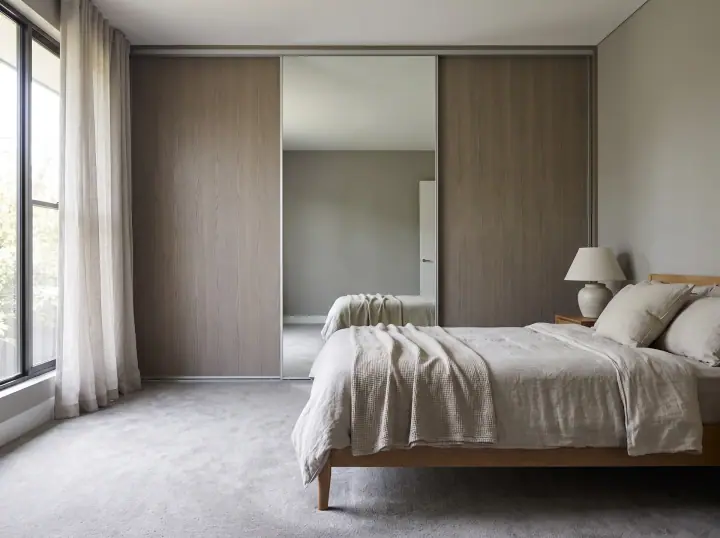
Top-hung (aluminium track): the door hangs from ball-bearing rollers in a track at the top, with a guide at the bottom that keeps it in line but carries no weight. Nothing to collect dust where it matters, nothing to wear flat, and the rollers adjust up and down. Standard on Reflections wardrobes.
Which one you have decides what can be fixed.
Problem: the door jumps off the track
- Bottom-rolling: a worn or flat-spotted wheel, or grit in the channel. Vacuum the channel, wipe it, and check the wheels. Replacement wheels help for a while.
- Top-hung: rare. If the bottom guide has come loose, the door swings and can slip. Refit the guide.
Problem: the door drags or is heavy
- Both systems: dust and a sock in the bottom guide or channel. Vacuum and wipe.
- Bottom-rolling: worn wheels. Replace, or accept that it is time for new doors.
- Top-hung: a roller set too low so the door rubs the floor guide, or the track screws loosened. Adjust the roller up through the access point in the frame.
Problem: the door sits crooked, gap wider at one end
- Top-hung: the two rollers are at different heights. A quarter turn on the adjustment screw levels it. The installer shows you where it is on install day.
- Bottom-rolling: usually a worn wheel on one side. Replace, or replace the door.
Problem: the doors rattle or bang
- Rattle when sliding: the bottom guide is loose or worn. Tighten or replace.
- Bang at the end: no soft-close or stop. Soft-close dampers can be added to a top-hung system.
- Rattle in wind: a door that is too light for the opening, or missing its bottom guide.
Problem: mirror or glass door feels unsafe
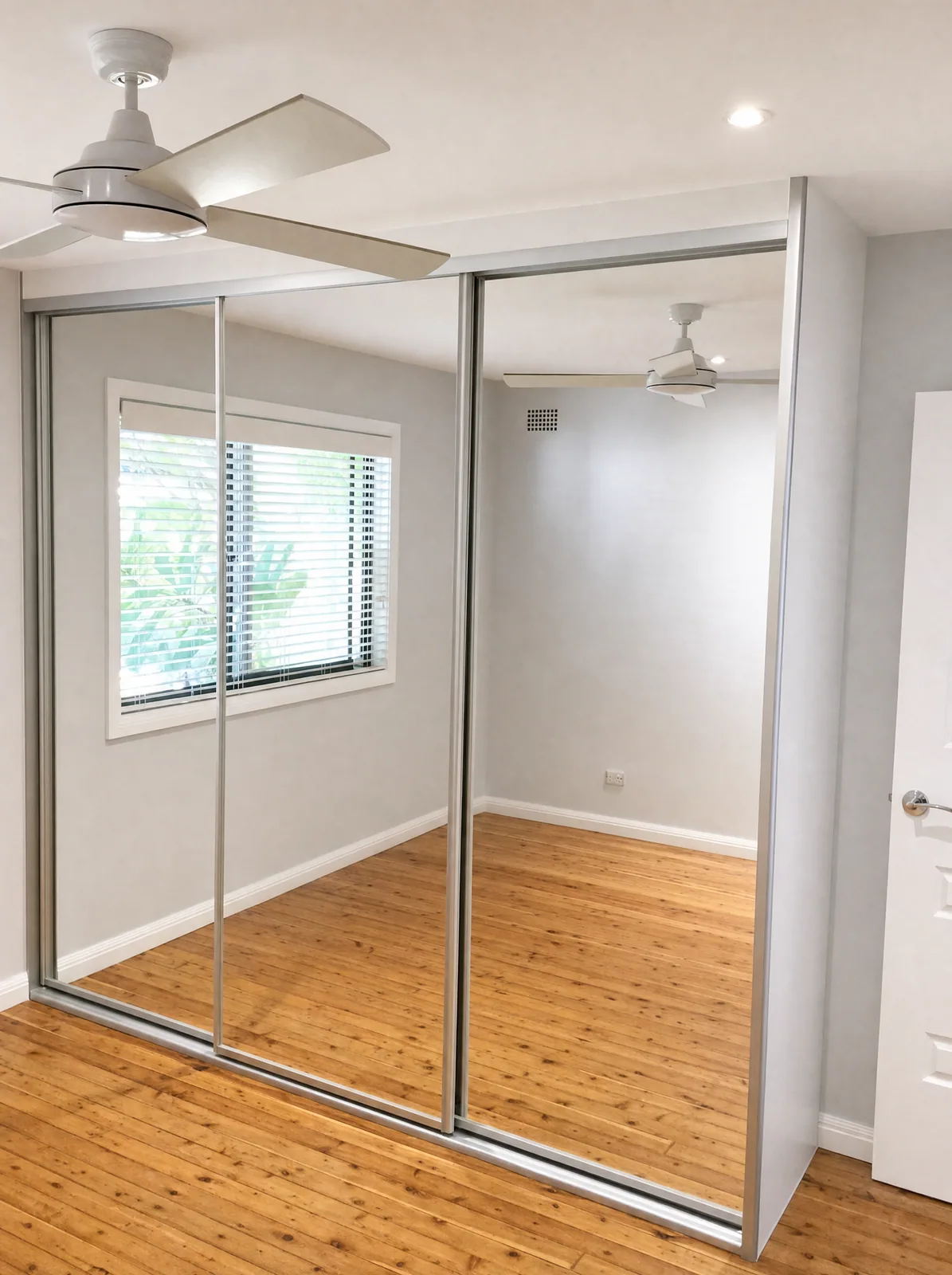
A heavy mirror door on a bottom-rolling system is a door waiting to jump. Mirror and glass doors should be top-hung; if yours is not, replacing the doors and track is the right call. Wardrobe mirror doors are safety-backed, so the glass stays on the backing if it ever breaks.
Problem: vinyl is peeling off the doors
Not a track problem, but it appears with the others. Vinyl-wrap doors fail in heat and at the edges and cannot be re-covered well. New doors in polytec board, mirror or glass are the fix. Our door comparison covers the options.
Fix or replace
| Symptom | Bottom-rolling | Top-hung |
|---|---|---|
| Jumps the track | Clean, then replace doors | Refit bottom guide |
| Drags | Clean, replace wheels, then replace doors | Clean, adjust roller |
| Crooked | Replace wheel, then replace doors | Adjust roller |
| Rattles | Replace guide | Tighten guide, add dampers |
| Peeling vinyl | Replace doors | Replace doors |
If the doors are bottom-rolling and more than a few years old, replacing them with top-hung doors on an aluminium track in the same opening is usually the economical answer, and the internals can be re-fitted at the same time. Our replacing an old wardrobe guide covers what happens.
Keeping a good system good
Vacuum the bottom guide when you vacuum the room. Do not oil the track. If a door starts to sit unevenly, adjust the roller early. Our care guide has the rest.
At the consult
If the doors are the problem, the designer looks at the opening and the existing internals and tells you whether new doors alone, or doors and internals together, make sense. New doors are made to the opening in our Blacktown factory and hung by the licensed installer who measured them, with a 10-year workmanship guarantee.