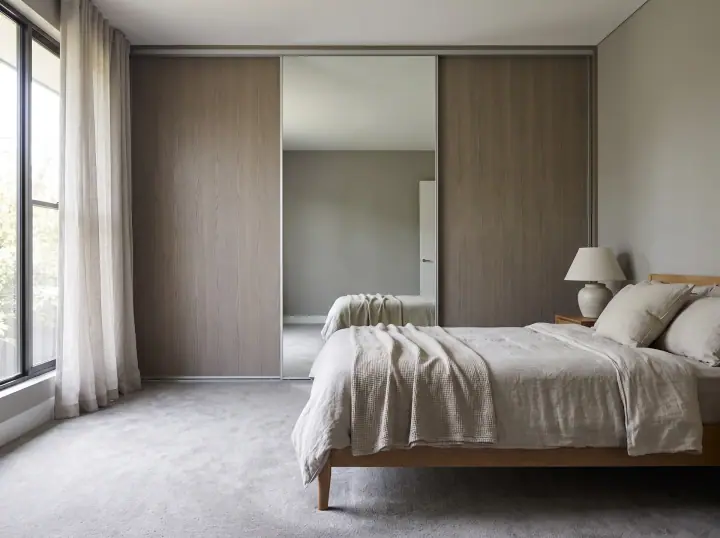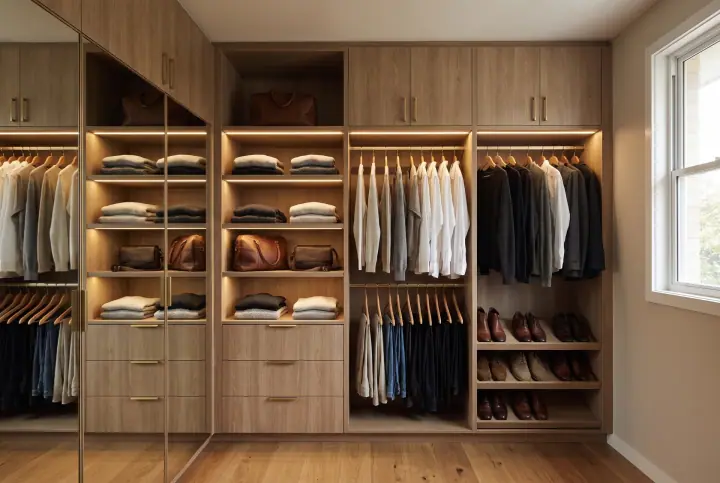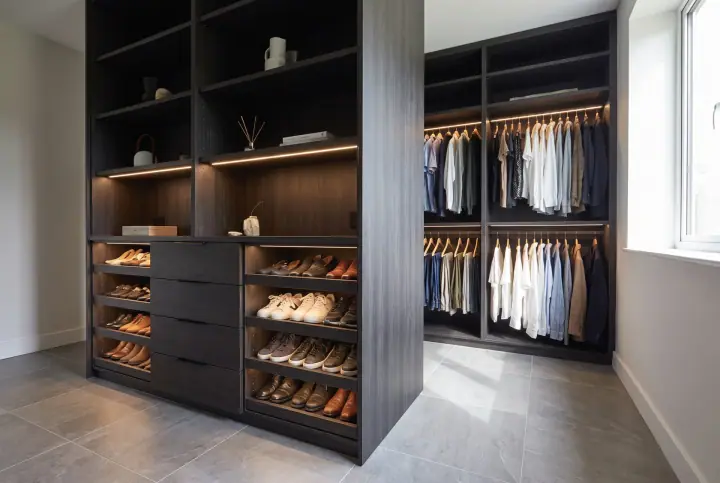
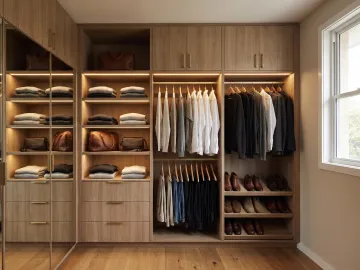
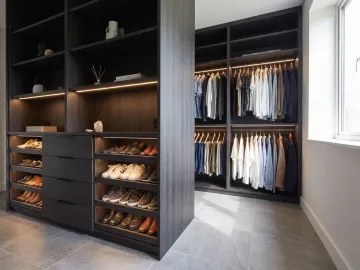
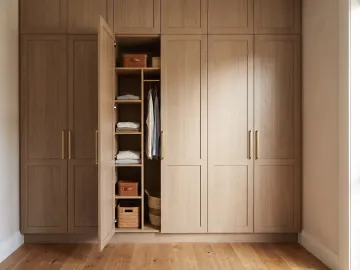
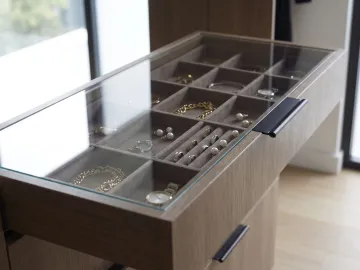
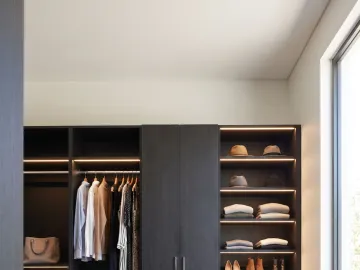
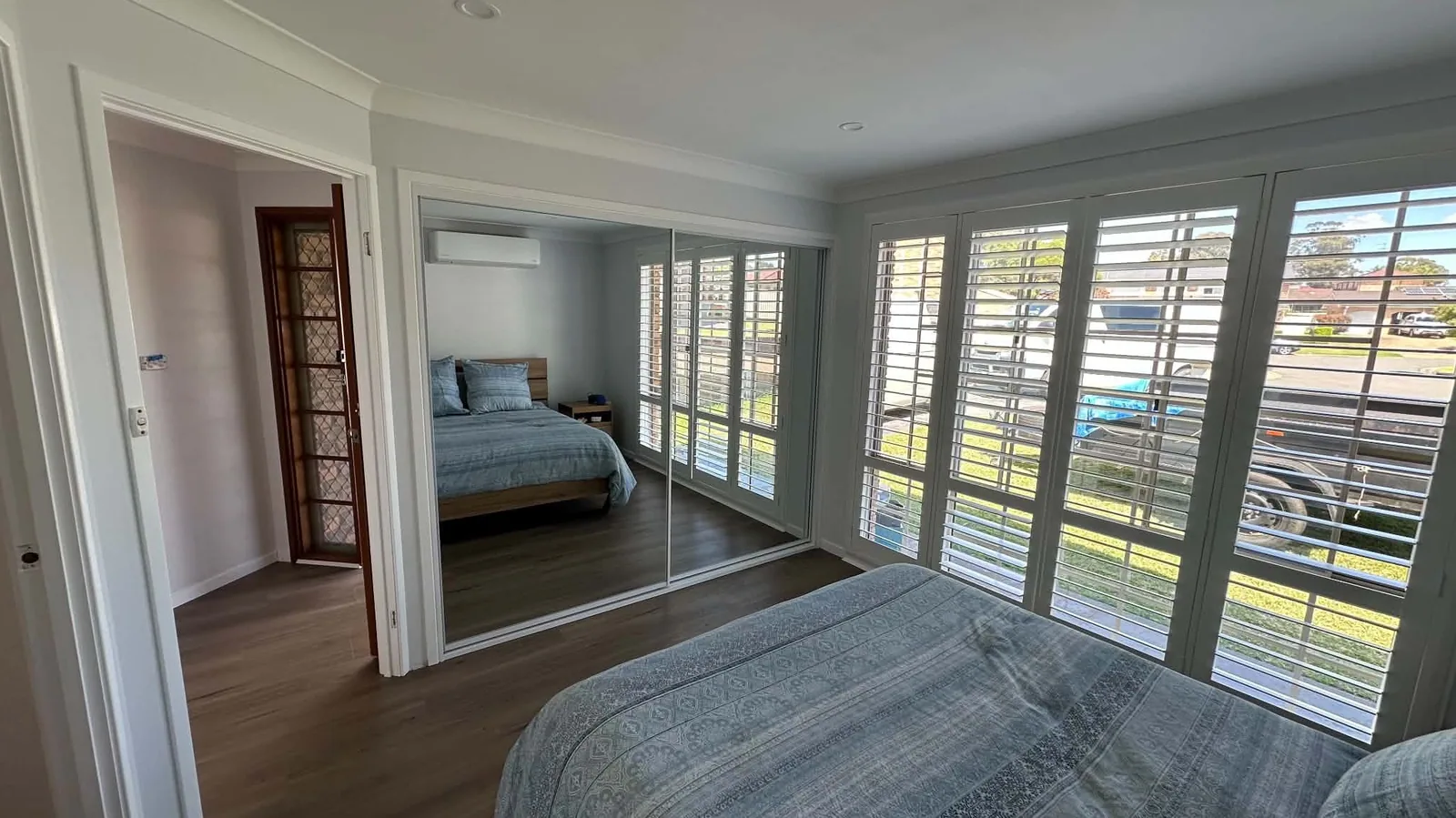
Short answer: in Sydney, a custom built-in wardrobe is usually quoted per job after an onsite measure, and the biggest cost drivers are the width of the opening, the door type and the internals you choose. Published Australian trade-marketplace figures put custom built-ins at roughly $1,100 to $3,000 per linear metre depending on design, materials and size. A standard bedroom robe of 2.4 to 3 metres therefore lands in a wide band, which is why the honest answer is a measured quote, not a number off a website.
This guide explains where the money goes, so you can read a quote properly and compare two of them fairly.
What you are actually paying for
A built-in wardrobe quote covers five things, in roughly this order of cost:
- Doors. The most visible part and usually the largest single line. Sliding mirror, white glass, coloured panel or routed shaker, each sits at a different price point.
- Carcass and internals. The board, the shelving, the hanging rails, the drawer banks. More drawers means more cost, because a drawer is a small cabinet in its own right.
- Size. Width, mostly. Height matters less than you would think, because going to the ceiling uses the same board you were already cutting.
- Hardware. Tracks, runners, hinges and handles. Ball-bearing runners and aluminium tracks cost more than their budget equivalents, and they are the parts that decide whether the wardrobe still glides in ten years.
- Installation. Measuring, factory time, delivery, fitting and making good. On a custom job this is skilled work by the person who designed it, not an assembly fee.
The cost drivers, one at a time
Door type
From least to most expensive, as a rule of thumb:
- Flat panel doors in a standard polytec colour. Clean, hard-wearing, the economical choice.
- Routed shaker or raised-profile doors. The same board, with a profile machined into the face. Adds factory time.
- White glass or mirror sliding doors. Glass costs more than board, and the frames and tracks are heavier-duty to carry it.
- Combinations. A mirror centre panel between two panel doors is a popular middle ground that keeps the cost between the two.
Sliding or hinged
Sliding doors need a track and rollers; hinged doors need hinges and a frame. Neither is dramatically dearer than the other on the door itself, but sliding systems with glass carry more hardware cost. Choose on how the room works, not on the small price difference. Our sliding vs hinged guide walks through that decision.
Internals
A single rail and a top shelf is the cheapest internal layout and the one most people are replacing. Each addition adds cost in a predictable way:
- Extra shelving: modest.
- Double hanging (two rails, one above the other): modest, and the best value upgrade in the wardrobe.
- Drawer bank: the most significant internal addition, because each drawer is built, fitted with runners and finished on the front.
- Shoe shelving, pull-out baskets, pant racks and tie racks: priced per item.
Width and the room itself
A 1.8 metre opening and a 3.6 metre opening are not the same job. Out-of-square walls, bulkheads, skirting boards and cornices all add measuring and cutting time, which is why a wardrobe designed from an onsite measure costs more than a module ordered from a chart, and why it fits.
Reading two quotes side by side
Two Sydney quotes for “a built-in wardrobe” can be hundreds or thousands apart and both be fair. Check these before deciding one is dearer:
- Board thickness. 16mm and 18mm carcasses are standard for custom work. Thinner board is a corner cut.
- Door board. polytec’s 9mm wardrobe door range is purpose-made for sliding doors. Ask what the doors are made from.
- Runners and tracks. Ask whether drawers are on ball-bearing runners and whether sliding doors run on an aluminium track.
- Who measures, who installs. A sales rep who hands the job to a subcontractor is a different service from a licensed installer who measures, designs and fits the job personally.
- Guarantee. A workmanship guarantee in writing, and how long it runs.
- Removal of the old wardrobe. Included or extra.
- GST. Quoted in or out.
Where to spend and where to save
If the budget is tight, spend on the parts you touch every day and save on the parts you do not:
- Spend on door hardware and drawer runners. They are the moving parts.
- Spend on double hanging. It roughly doubles usable hanging for a small outlay.
- Save by choosing flat panel doors over routed profiles.
- Save by keeping existing doors and re-fitting the internals only, if the doors are sound.
- Save by choosing fewer, larger drawers over many small ones.
How Reflections quotes
We do not publish a price list, because no two openings are the same. The process is an onsite consultation at your home: the designer measures the opening, talks through what you own and how you dress, and draws up a layout. You receive a quote for that specific wardrobe, with the door type, internals and removal of any old wardrobe spelled out. The designer who measures is the licensed installer who fits the job, and every wardrobe is made in our Blacktown factory with a 10-year workmanship guarantee.
If you are weighing up a few options, bring them to the consult. It is the quickest way to put real numbers against each one.