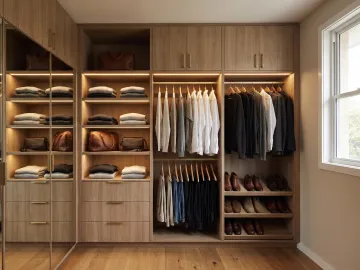
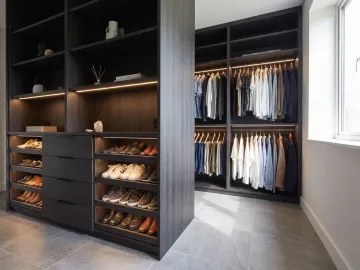
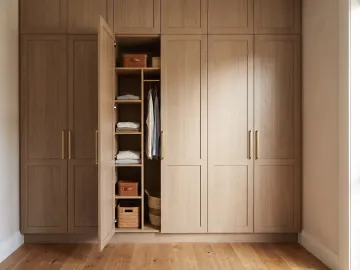
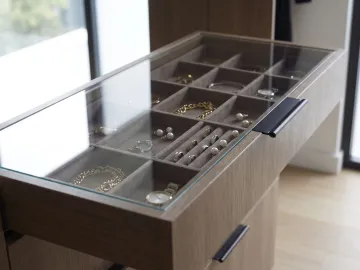
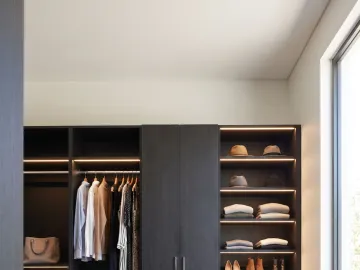
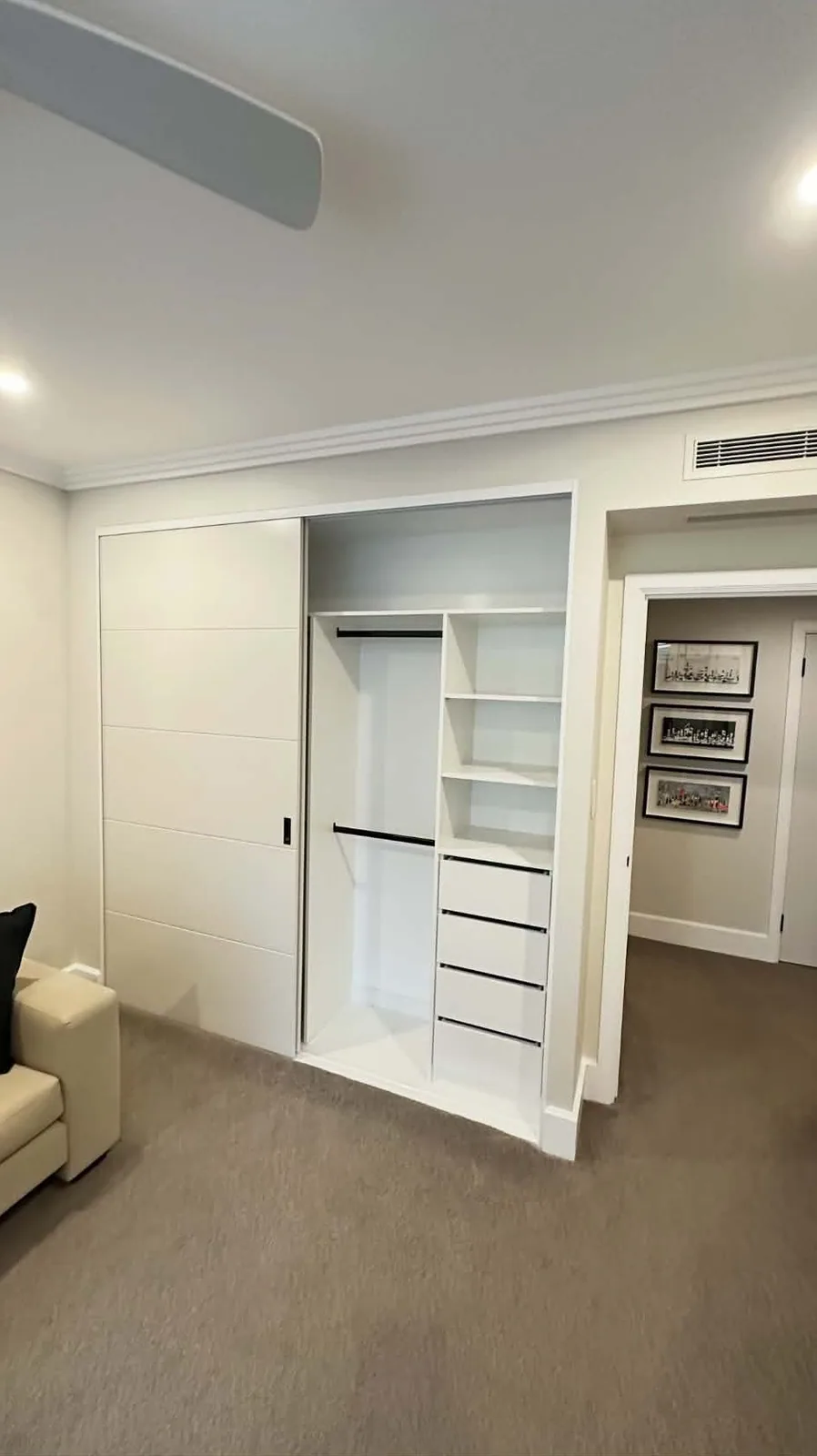
Short answer: an accessible wardrobe keeps everything between knee and shoulder height, uses full-extension drawers instead of deep shelves, adds a pull-down rail for any hanging that has to be high, uses sliding doors with a light action, and has sensor lighting. The aim is that nothing needs a stretch, a bend to the floor or a step stool.
The reach zone
For a standing adult with limited reach, the comfortable zone is roughly 600 to 1,500mm from the floor. For a seated person, 400 to 1,200mm. Everything used daily goes in that band; the rest goes above or below.
Hanging
- Single rail at 1,200 to 1,400mm rather than double hanging at 1,000 and 2,000mm. The lower rail is reachable; the upper rail is not.
- Pull-down rail where a higher rail is unavoidable: a spring-assisted arm brings the rail down to chest height with a handle, then lifts it back up.
- Shorter rail sections so the clothes do not need to be pushed along a long rail.
Drawers, not deep shelves
A deep shelf at knee height means bending and reaching to the back. Drawers on full-extension runners bring everything forward.
- Full-extension, soft-close, ball-bearing runners, so the drawer comes all the way out with a light pull and closes itself.
- Drawer fronts with large handles or a wide finger pull, easy to grip.
- Drawers between 600 and 1,200mm from the floor. Nothing on the bottom.
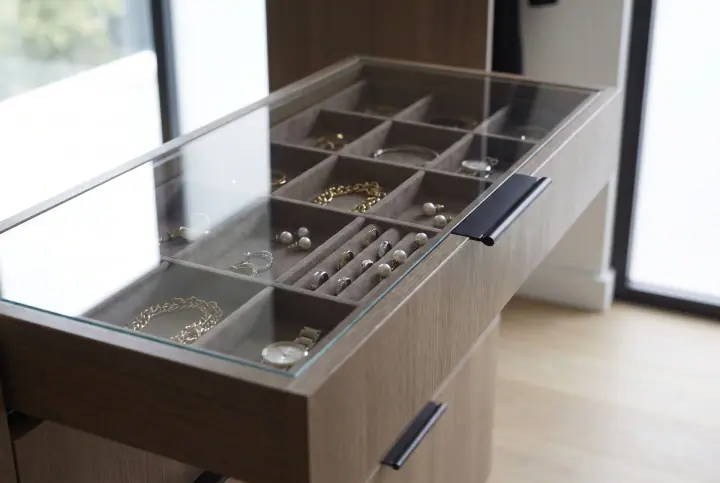
- Shallow drawers for small things, so nothing is buried.
Shelves
- Shelves at 350mm spacing between 700 and 1,500mm, for folded clothes.
- Nothing deeper than 400mm.
- The top shelf for things someone else can get down: luggage, the off-season.
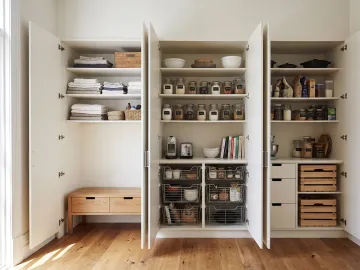
- Pull-out shelves on runners where a deep bay cannot be avoided.
Shoes
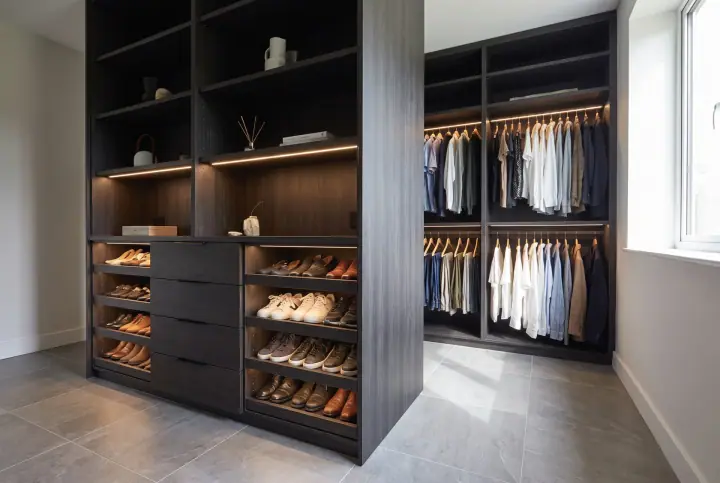
A shoe shelf at 400 to 600mm with a bench or a chair nearby, so shoes go on sitting down. A pull-out shoe rack in a hinged robe brings the shoes forward.
Doors
Sliding doors on top-hung ball-bearing rollers open with a fingertip, need no clearance and cannot be walked into. A recessed finger pull is easy to grip. Mirror doors double as a full-length mirror without a separate fitting.
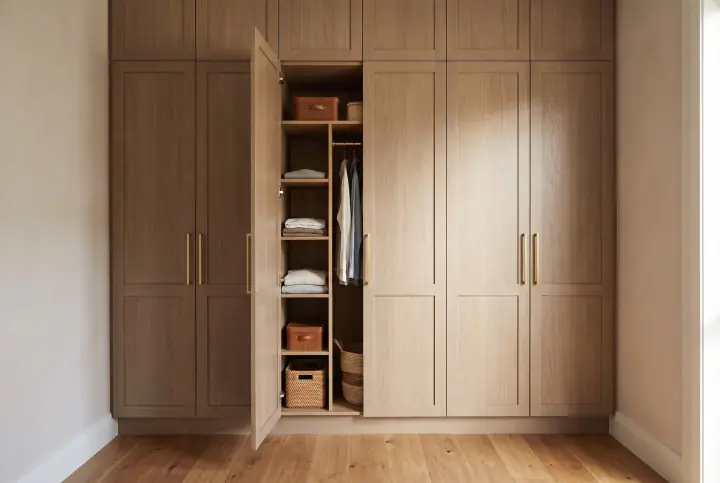
Hinged doors give full access but need swing room. If chosen, soft-close hinges with a stay, and large handles.
For a walk-in, no doors on the storage, and a wide entry with no step.
Lighting
An LED strip on a door sensor or a motion sensor, so the wardrobe lights when it is opened or entered and no switch is needed. Warm white, diffused. Our lighting guide has the options.
Walk-ins
A walk-in suits a walker or a wheelchair if the walkway is 900mm or wider, the floor is level with the bedroom, and the storage is kept in the reach zone on each wall. A seat inside is worth having.
A layout for a 2,400mm built-in
| Bay | Width | Contents |
|---|---|---|
| Left | 900mm | Rail at 1,300mm, shelf above for the off-season (someone else’s job) |
| Centre | 900mm | Pull-down rail for longer hanging, shoe shelf at 500mm |
| Right | 600mm | Drawer bank from 600 to 1,300mm, full-extension, shelf above |
Sliding doors, mirror on the end door, sensor lighting.
Adapting an existing wardrobe
Most of this is internals, so an existing wardrobe with sound doors can be re-fitted: lower rails, a pull-down rail, a drawer bank on full-extension runners and a lighting strip. If the doors are heavy or on a floor track, replacing them with top-hung sliders is the other change that matters.
At the consult
Tell the designer who will use the wardrobe and how they move. Rail heights, drawer positions and door choice are set for that person, not for a chart. The wardrobe is made in our Blacktown factory and fitted by the licensed installer who designed it.