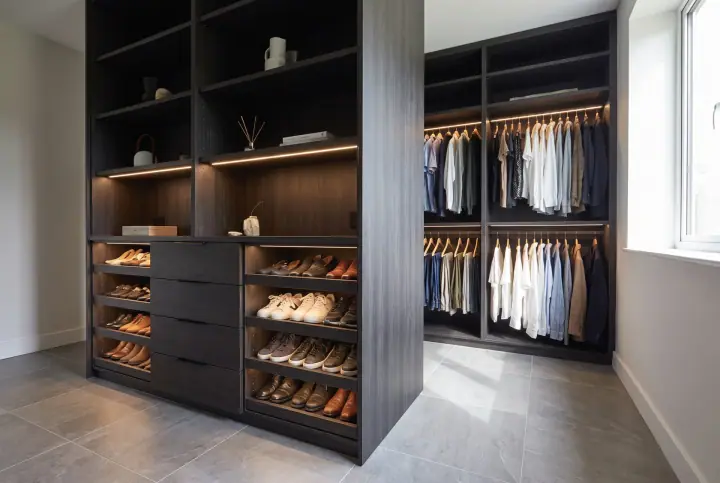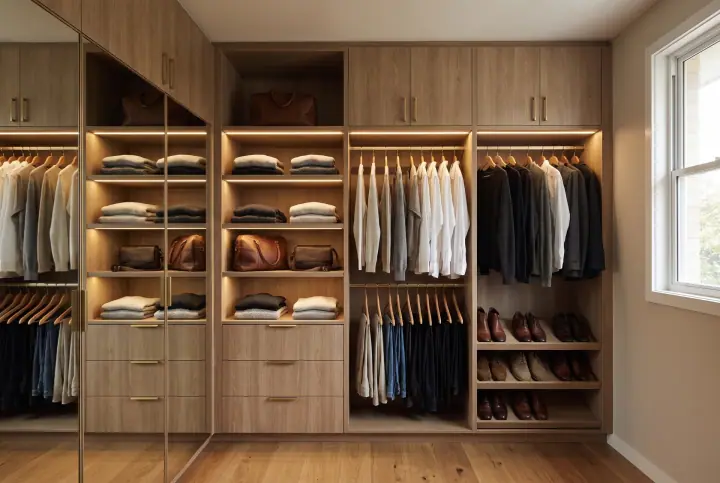
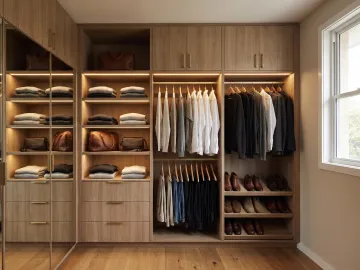
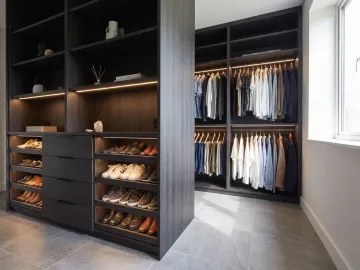
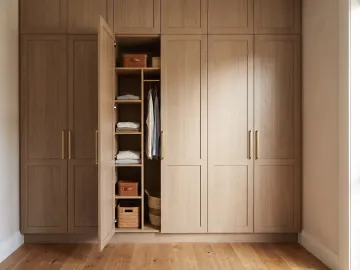
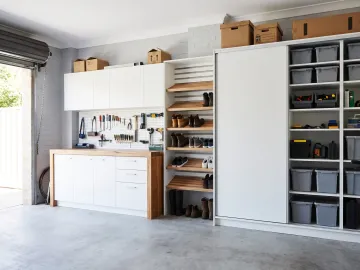
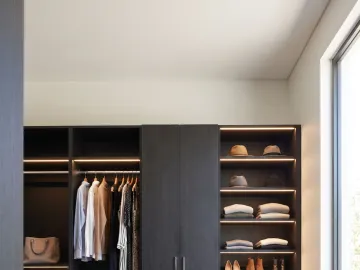
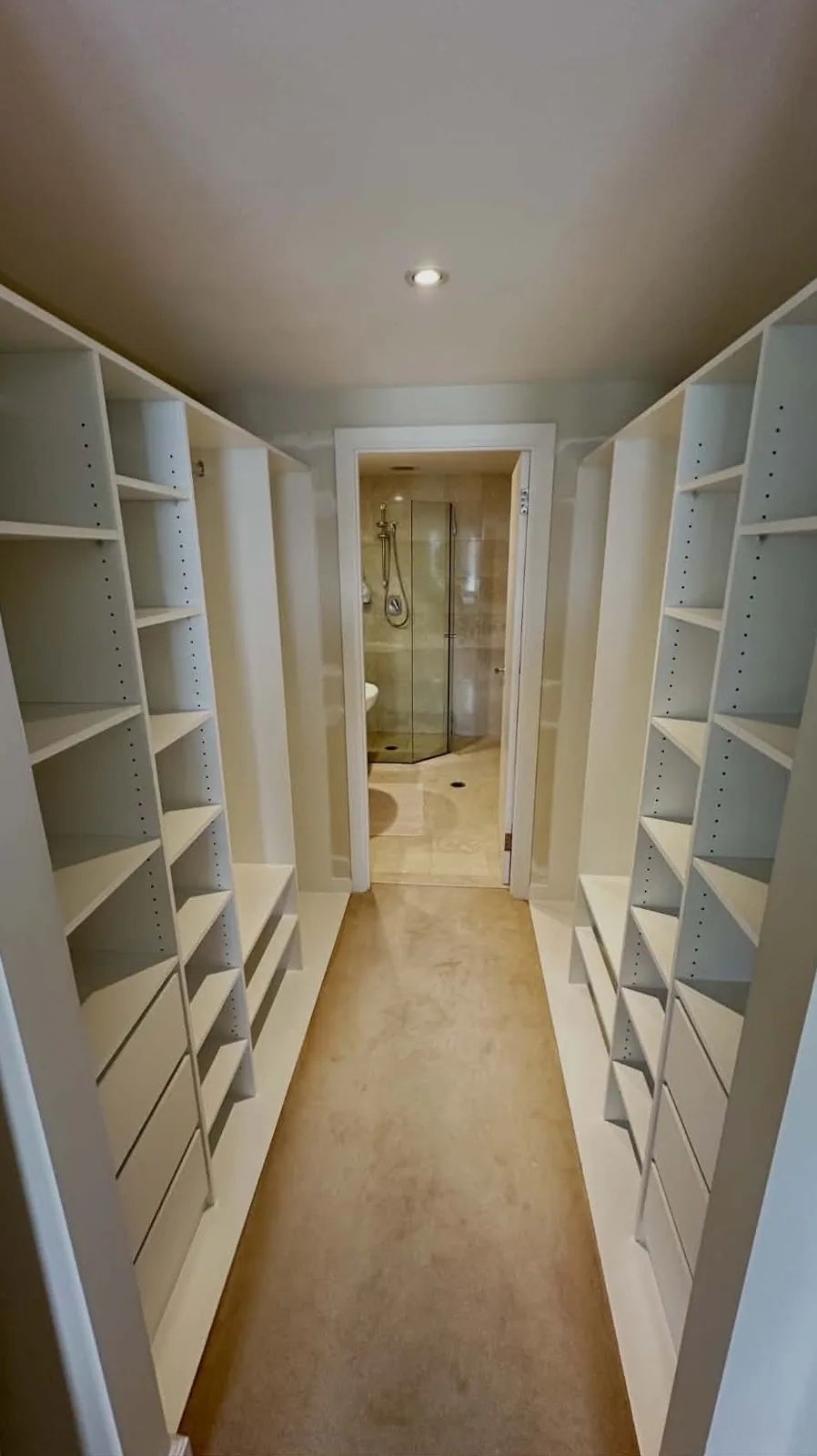
Short answer: shoes belong on angled or flat shelves in their own bay, not on the wardrobe floor. Count the pairs, allow about three to four pairs per 900mm of shelf, and set shelf spacing at about 180 to 200mm for flats and trainers and 350 to 400mm for boots. In a built-in, the shoe bay is usually the bottom third of one bay; in a walk-in, the end wall.
Why the floor does not work
The wardrobe floor is where shoes go when nobody planned for them. They end up two deep, the back pairs disappear, and the floor is where dust collects. Shelving solves all three: every pair visible, nothing behind anything, and the floor clear.
The options
Angled shoe shelves
Shelves set at a tilt of about 15 degrees with a lip at the front, so the shoe sits toe-down and the whole shoe is visible from standing height. The classic shop-fit look.
- Best for: walk-ins and the bottom of a built-in, where you look down at the shoes.
- Holds: three to four pairs per 900mm, one pair deep.
Flat shelves at close spacing
Plain adjustable shelves at 180 to 200mm spacing. Shoes sit flat, side by side.
- Best for: built-ins, where the bay is narrow and angled shelves lose space to the tilt. Also boots, with a taller gap.
- Holds: the same as angled, with a little more flexibility.
Pull-out shoe rack
A wire or timber rack on runners that pulls out from a bay or from behind a hinged door, so you see all the shoes at once.
- Best for: hinged robes and deep cupboards where the shoes would otherwise be at the back.
- Holds: two rows per pull-out.
Dedicated shoe bay
One full-height bay of a walk-in, or the end wall, given over to shoe shelves from floor to eye level, with the top shelves for boxes or seasonal shoes.
- Best for: large collections.
- Holds: a 600mm-wide bay with ten shelves takes about 25 to 30 pairs.
Cubbies
Individual pigeon-holes, one pair each. Tidy, and each pair has an address.
- Best for: kids’ rooms and small collections.
- Holds: fewer per metre than shelves, because of the dividers.
Where to put it
| Wardrobe | Put the shoes |
|---|---|
| Sliding or hinged built-in | Bottom third of one bay, flat or angled shelves |
| Walk-in, galley | End wall, floor to eye level |
| Walk-in, L or U | The shortest wall, or under the long hanging |
| Hinged robe with deep return | Pull-out rack behind the door |
| Kids’ room | Cubbies or two low shelves they can reach |
Sizing
- Width per pair: about 220 to 250mm for adult shoes side by side.
- Shelf depth: 300 to 350mm, so the shoe sits fully on the shelf.
- Spacing: 180 to 200mm for flats, trainers and heels; 350 to 400mm for ankle boots; a floor space with no shelf above for knee boots.
- Growth: add a third. Shoe collections only go one way.
Small details that help
- A low shelf for everyday shoes at the front, so the pairs you wear most are the easiest to reach.
- Boxes on the top shelves for shoes you wear a few times a year, labelled.
- Lighting. A strip above the shoe shelves makes a big difference in a walk-in.
- A gap under the bottom shelf so the floor can be vacuumed.
At the consult
Count the pairs, note which are boots, and tell the designer. The shoe bay is sized to the collection, shelves are adjustable, and it is built into the same cabinetry as the rest of the wardrobe. If you are re-fitting an existing wardrobe, shoe shelving is one of the simplest additions.